Happenings

Sermons by Pastor Walter Snyder plus announcements, articles, videos, and anything else that doesn’t fit Ask the Pastor or the Luther Library.


23 August 2020

Proper 16A Sermon: The Gates of Hades

Preached on Matthew 16:13–20
The Twelfth Sunday after Pentecost
23 August AD 2020

Video: Click to view the YouTube video of The Gates of Hades.

Audio: Alternatively, choose The Gates of Hades to hear the MP3.

Matthew 16:13–20 Summary: The rock upon which Jesus builds His Church isn’t Peter but rather Peter’s confession. Confessing Jesus as the Christ, Peter thus identified Him as the “spiritual Rock” of whom Israel drank, for “the Rock was Christ. (1 Corinthians 10:4)”

Being built on this Rock gives us the fruits of His victories over sin, death, and devil. The “Son of the Living God” died for us yet He is still the living Son of God. Death comes because of sin. Jesus’ resurrection guarantees that our sins which He carried to the cross are blotted out and cannot hold Him — or us — bound by Hades and eternally trapped in the grave. Jesus kicked down death’s door and grants believers egress into everlasting life.

Text: Now when Jesus came into the district of Caesarea Philippi, he asked his disciples, “Who do people say that the Son of Man is?”

And they said, “Some say John the Baptist, others say Elijah, and others Jeremiah or one of the prophets.”

He said to them, “But who do you say that I am?”

Simon Peter replied, “You are the Christ, the Son of the living God.”

And Jesus answered him, “Blessed are you, Simon Bar-Jonah! For flesh and blood has not revealed this to you, but my Father who is in heaven. And I tell you, you are Peter, and on this rock I will build my church, and the gates of hell shall not prevail against it. I will give you the keys of the kingdom of heaven, and whatever you bind on earth shall be bound in heaven, and whatever you loose on earth shall be loosed in heaven.”

Then he strictly charged the disciples to tell no one that he was the Christ. Matthew 16:13–20

Scripture quoted from The Holy Bible, English Standard Version®, © 2001 by Crossway Bibles, a publishing ministry of Good News Publishers. Used by permission. All rights reserved.

Video: Click to view the YouTube video of The Gates of Hades.

Audio: Alternatively, choose The Gates of Hades to hear the MP3.

Other Readings: Psalm 138; Isaiah 51:1–6; Romans 11:33–12:8

Labels: , , , , , , , , , , , ,

14 June 2020

Proper 6A Sermon: Perfect Timing

Preached on Romans 5:6–15
The Second Sunday after Pentecost
14 June AD 2020

Video: Click to view the YouTube video of Perfect Timing.

Audio: Alternatively, choose Perfect Timing to hear the MP3.

Romans 5:6–15 Summary: Adam brought sin and death into the world through his fall but at the absolutely correct time Jesus reconciled us to God through His suffering and death and gave us life by His resurrection.

Text: For while we were still weak, at the right time Christ died for the ungodly. For one will scarcely die for a righteous person — though perhaps for a good person one would dare even to die — but God shows his love for us in that while we were still sinners, Christ died for us.

Since, therefore, we have now been justified by his blood, much more shall we be saved by him from the wrath of God. For if while we were enemies we were reconciled to God by the death of his Son, much more, now that we are reconciled, shall we be saved by his life. More than that, we also rejoice in God through our Lord Jesus Christ, through whom we have now received reconciliation.

Therefore, just as sin came into the world through one man, and death through sin, and so death spread to all men because all sinned — for sin indeed was in the world before the law was given, but sin is not counted where there is no law. Yet death reigned from Adam to Moses, even over those whose sinning was not like the transgression of Adam, who was a type of the one who was to come.

But the free gift is not like the trespass. For if many died through one man’s trespass, much more have the grace of God and the free gift by the grace of that one man Jesus Christ abounded for many. Romans 5:6–15

Scripture quoted from The Holy Bible, English Standard Version®, © 2001 by Crossway Bibles, a publishing ministry of Good News Publishers. Used by permission. All rights reserved.

Video: Click to view the YouTube video of Perfect Timing.

Audio: Click Perfect Timing to listen to the MP3.

Other Readings: Psalm 100; Exodus 19:2–8; Matthew 9:35–10:8

Labels: , , , , , , , , , , ,

26 April 2020

Easter 3A Sermon: Necessary Evil

Preached on Luke 24:13–35
The Third Sunday of Easter (Series A)
Responsive Prayer 2 (LSB 285)
26 April AD 2020

Video: Click to view the YouTube video of Necessary Evil. Responsive Prayer 2 from the Lutheran Service Book begins with the Opening Versicles (LSB 285), Psalm 116:1–14, and the Readings. The sermon starts at the 7:45 mark. The service concludes with the Kyrie (LSB 285), Lord’s Prayer (LSB 285), Apostles’ Creed (LSB 286), Versicles (286), Collect of the Day, Collect During an Epidemic, Morning Prayer (LSB 287), Benedicamus (LSB 287), and Benediction (LSB 287).

Audio: Alternatively, choose Necessary Evil, MP3 audio of the sermon only.

Luke 24:13–35 Summary: When we talk about “necessary evils,” we normally mean something harsh or painful that we must endure in order to reach a satisfactory and pleasing conclusion. At times, we even use “necessary evil” as another way of saying, “The ends justify the means” — in other words, an excuse to take short-cuts or to sin in some way in order to achieve our goal.

Jesus enlightened the disciples on the Emmaus Road by showing them from the Scriptures that He endured the necessary evil of suffering before achieving His goal and entering glory. Because He endured the necessary, prophesied evils of betrayal, abandonment, torture, and death, the Lord destroyed the power of sin and death and won for us everlasting life.

Text: That very day two of them were going to a village named Emmaus, about seven miles from Jerusalem, and they were talking with each other about all these things that had happened. While they were talking and discussing together, Jesus himself drew near and went with them. But their eyes were kept from recognizing him.

And he said to them, “What is this conversation that you are holding with each other as you walk?”

And they stood still, looking sad. Then one of them, named Cleopas, answered him, “Are you the only visitor to Jerusalem who does not know the things that have happened there in these days?”

And he said to them, “What things?”

And they said to him, “Concerning Jesus of Nazareth, a man who was a prophet mighty in deed and word before God and all the people, and how our chief priests and rulers delivered him up to be condemned to death, and crucified him. But we had hoped that he was the one to redeem Israel. Yes, and besides all this, it is now the third day since these things happened.

“Moreover, some women of our company amazed us. They were at the tomb early in the morning, and when they did not find his body, they came back saying that they had even seen a vision of angels, who said that he was alive. Some of those who were with us went to the tomb and found it just as the women had said, but him they did not see.”

And he said to them, “O foolish ones, and slow of heart to believe all that the prophets have spoken! Was it not necessary that the Christ should suffer these things and enter into his glory?” And beginning with Moses and all the Prophets, he interpreted to them in all the Scriptures the things concerning himself.

So they drew near to the village to which they were going. He acted as if he were going farther, but they urged him strongly, saying, “Stay with us, for it is toward evening and the day is now far spent.” So he went in to stay with them.

When he was at table with them, he took the bread and blessed and broke it and gave it to them. And their eyes were opened, and they recognized him. And he vanished from their sight. They said to each other, “Did not our hearts burn within us while he talked to us on the road, while he opened to us the Scriptures?”

And they rose that same hour and returned to Jerusalem. And they found the eleven and those who were with them gathered together, saying, “The Lord has risen indeed, and has appeared to Simon!” Then they told what had happened on the road, and how he was known to them in the breaking of the bread. Luke 24:13–35

Scripture quoted from The Holy Bible, English Standard Version®, © 2001 by Crossway Bibles, a publishing ministry of Good News Publishers. Used by permission. All rights reserved.

Video: Click to view the YouTube video of Necessary Evil. Sermon begins at the 7:45 mark.

Audio: Click Necessary Evil for MP3 audio of just the sermon.

Other Readings: Psalm 116:1–14; Acts 2:14a, 36–41; 1 Peter 1:17–25

Labels: , , , , , , , , , ,

19 April 2020

Easter 2A Sermon: Tested Genuine

Preached on 1 Peter 1:3–9
The Second Sunday of Easter (Series A)
A Spoken Order of Morning Prayer (LSB 235)
19 April AD 2020

Video: Click to view the YouTube video of Tested Genuine. Morning Prayer from the Lutheran Service Book begins with the Verse (235), the Psalmody (LSB 235–237) with the Venite and Psalm 148, and the Readings with Responses (LSB 238). The sermon starts at the 9:35 mark. The service concludes with the Benedictus (LSB 238–240), Collect of the Day, Prayer of the Church, Collect for Grace (LSB 241), Lord’s Prayer, Benedicamus (LSB 241), and Benediction (LSB 242).

1 Peter 1:3–9 Summary: We join Peter in blessing “the God and Father of our Lord Jesus Christ” because He sent His Son to die for us, forgive our sins, and give us the gift of everlasting life. This salvation is ours by faith in Jesus.

However, our faith isn’t completely fulfilled until the Last Day. Then we will finally receive the fulness of our inheritance.

Until then, we’ll face trials and temptations because we are still weak and sinful. Many will also endure testing especially because of their faith in Christ. No matter the cause or source of our trials, Peter compares them to the “testing” or refining process where precious gold is separated from rocks and base metals.

Yet there’s an important difference. Gold may be lost or stolen. Given a hot enough fire, it can even be burned away. But the faith that endures through our trials is “more precious” because faith is what receives God’s gift of salivation in Christ. When we triumph through earthly testing, Jesus presents us to His Father as complete pure and infinitely more valuable that the costliest of precious metals.

Text: Blessed be the God and Father of our Lord Jesus Christ! According to his great mercy, he has caused us to be born again to a living hope through the resurrection of Jesus Christ from the dead, to an inheritance that is imperishable, undefiled, and unfading, kept in heaven for you, who by God’s power are being guarded through faith for a salvation ready to be revealed in the last time.

In this you rejoice, though now for a little while, if necessary, you have been grieved by various trials, so that the tested genuineness of your faith — more precious than gold that perishes though it is tested by fire — may be found to result in praise and glory and honor at the revelation of Jesus Christ.

Though you have not seen him, you love him. Though you do not now see him, you believe in him and rejoice with joy that is inexpressible and filled with glory, obtaining the outcome of your faith, the salvation of your souls. 1 Peter 1:3–9

Scripture quoted from The Holy Bible, English Standard Version®, © 2001 by Crossway Bibles, a publishing ministry of Good News Publishers. Used by permission. All rights reserved.

Video: Click to view the YouTube video of Tested Genuine. Sermon begins at the 9:35 mark.

Other Readings: Psalm 148; Acts 5:29–42; John 20:19–31

Labels: , , , , , , , , , , ,

13 August 2017

Pentecost 10 Sermon: Dying with God

Preached on Job 38:4-18
10th Sunday After Pentecost— Proper 14A
13 August AD 2017

Title: Click to hear the MP3 of Dying with God.

Resurrection Summary: When the Lord challenges us as He did Job, we can certainly answer one of His questions in the affirmative: “The gates of death” have been revealed to us. Christ burst them open and tore them down. We passed through them in Baptism. For in Baptism, we died with Jesus on the cross and in Baptism we crossed over to everlasting life in Him.

Text: [The Lord said to Job,] “Where were you when I laid the foundation of the earth? Tell me, if you have understanding. Who determined its measurements — surely you know! Or who stretched the line upon it? On what were its bases sunk, or who laid its cornerstone, when the morning stars sang together and all the sons of God shouted for joy?

“Or who shut in the sea with doors when it burst out from the womb, when I made clouds its garment and thick darkness its swaddling band, and prescribed limits for it and set bars and doors, and said, ‘Thus far shall you come, and no farther, and here shall your proud waves be stayed’?

“Have you commanded the morning since your days began, and caused the dawn to know its place, that it might take hold of the skirts of the earth, and the wicked be shaken out of it?

“It is changed like clay under the seal, and its features stand out like a garment. From the wicked their light is withheld, and their uplifted arm is broken.

“Have you entered into the springs of the sea, or walked in the recesses of the deep? Have the gates of death been revealed to you, or have you seen the gates of deep darkness? Have you comprehended the expanse of the earth? Declare, if you know all this.” Job 38:4-18

Scripture quoted from The Holy Bible, English Standard Version®, © 2001 by Crossway Bibles, a publishing ministry of Good News Publishers. Used by permission. All rights reserved.

Audio: Click to hear the MP3 of Dying with God.

NB: A few people have had problems trying to play the inline audio with Windows Media Player. If this occurs, you can either change to QuickTime or another default browser player, copy and paste the link directly into a selected player, or download it to your computer, where it seems to work regardless of which player. Several folks have suggested VLC Player from VideoLAN.

Other Readings: Psalm 18:1-6 (7-16); Romans 10:5-17; Matthew 14:22-33

Labels: , , , , , , , , , , , , , , , , ,

09 July 2017

Trinity 4 Sermon: God Meant It for Good

Preached on Genesis 50:15-21
Fourth Sunday After Trinity
9 July AD 2017

Title: Click to hear the MP3 of God Meant It for Good.

Genesis 50:15-21 Summary: “You meant evil ... but God meant it for good.” As Joseph calmed his fearful brothers, so Christ calms our fears. Sinful mankind, hatefully condemning and slaying the sinless Son of God, found forgiveness and life in the very death that it brought about.

Text: When Joseph’s brothers saw that their father was dead, they said, “It may be that Joseph will hate us and pay us back for all the evil that we did to him.”

So they sent a message to Joseph, saying, “Your father gave this command before he died: ‘Say to Joseph, “Please forgive the transgression of your brothers and their sin, because they did evil to you.” ’ And now, please forgive the transgression of the servants of the God of your father.”

Joseph wept when they spoke to him. His brothers also came and fell down before him and said, “Behold, we are your servants.”

But Joseph said to them, “Do not fear, for am I in the place of God? As for you, you meant evil against me, but God meant it for good, to bring it about that many people should be kept alive, as they are today. So do not fear; I will provide for you and your little ones.” Thus he comforted them and spoke kindly to them. Genesis 50:15-21

Scripture quoted from The Holy Bible, English Standard Version®, © 2001 by Crossway Bibles, a publishing ministry of Good News Publishers. Used by permission. All rights reserved.

Audio: Click to hear the MP3 of God Meant It for Good.

NB: A few people have had problems trying to play the inline audio with Windows Media Player. If this occurs, you can either change to QuickTime or another default browser player, copy and paste the link directly into a selected player, or download it to your computer, where it seems to work regardless of which player. Several folks have suggested VLC Player from VideoLAN.

Other Readings: Psalm 138; Romans 12:14-21 or Romans 8:18-23; Luke 6:36-42

Labels: , , , , , , , , , , , , ,

25 June 2017

Pentecost 3 Sermon: Sheltered

Preached on Psalm 91:1-10
3rd Sunday After Pentecost— Proper 7A
25 June AD 2017

Title: Click to hear the MP3 of Sheltered.

Psalm 91:4 Summary: We live in an often violent world. We live under the threat of accident, disease, dementia, and death. And this is simply how we live as citizens of this planet.

Special wrath is often directed at the Church and its members. Believers— even if not targeted for discrimination, torture, or death by unbelievers— still face Satan’s wrath and wiles. On our own, we face certain doom and damnation.

Thanks be to God! He invites us to take refuge in Him. The psalmist paints the Lord as shade in the desert, battle armor proof against savage foes, a powerful eagle protecting its young. He who came to us in human flesh as Immanuel, God with Us, invites and empowers us to come into Him, our dwelling place and impregnable fortress.

Text: He who dwells in the shelter of the Most High will abide in the shadow of the Almighty.

I will say to the Lord, “My refuge and my fortress, my God, in whom I trust.”

For he will deliver you from the snare of the fowler and from the deadly pestilence. He will cover you with his pinions, and under his wings you will find refuge; his faithfulness is a shield and buckler.

You will not fear the terror of the night, nor the arrow that flies by day, nor the pestilence that stalks in darkness, nor the destruction that wastes at noonday.

A thousand may fall at your side, ten thousand at your right hand, but it will not come near you. You will only look with your eyes and see the recompense of the wicked.

Because you have made the Lord your dwelling place— the Most High, who is my refuge— no evil shall be allowed to befall you, no plague come near your tent. Psalm 91:1-10

Scripture quoted from The Holy Bible, English Standard Version®, © 2001 by Crossway Bibles, a publishing ministry of Good News Publishers. Used by permission. All rights reserved.

Audio: Click to hear the MP3 of Sheltered.

NB: A few people have had problems trying to play the inline audio with Windows Media Player. If this occurs, you can either change to QuickTime or another default browser player, copy and paste the link directly into a selected player, or download it to your computer, where it seems to work regardless of which player. Several folks have suggested VLC Player from VideoLAN.

Other Readings: Psalm 91:1-16; Jeremiah 20:7-13; Romans 6:12-23; Matthew 10:5a, 21-33

Labels: , , , , , , , , , , , , , , , ,

10 June 2017

Wedding Sermon: Strength and Song, Salvation and Confession

Preached on 1 Timothy 6:12 and Isaiah 12:2
The Marriage of Laura M. Snyder and Kyle L. Molitor
10 June AD 2017

Title: Strength and Song, Salvation and Confession (MP3 Audio)

The Wedding at Cana Summary: Besides the Scriptures included in the wedding rite, a pastor has many options when choosing a sermon text. When Laura and Kyle asked me to preach, I looked through the “usual suspects” and had an idea: The union of this man and this woman would include a joining of all they carried with them, including their confirmation verses.

With that in mind, I asked Laura to find out Kyle’s verse to see if it would work in unity with hers as a joint text. I was quite pleased when I discovered that his from 1 Timothy nicely complemented hers from Isaiah 12. Both confess that we have salvation and eternal life only through God in Christ Jesus.

Kyle and Laura completely agree that the most important love isn’t that between people but the love God has for fallen humanity. As I wove the themes of the two verses together, the Father’s boundless love and unconditional forgiveness through Jesus remained the unifying strand.

They will best live together and love together as they live in faith. They will forgive each other most completely as they realize how completely God forgives them. And they will most wholeheartedly sacrifice their own desires for each other as they embrace the sacrifice Christ made for them.

Note that the bulletin cover art I reference in the sermon is this Coptic illustration to the right. This vision of the Marriage at Cana beautifully shows our Savior sheltering husband and wife “under his wings.”

Snyder-Molitor Wedding Texts: Take hold of the eternal life to which you were called and about which you made the good confession in the presence of many witnesses. 1 Timothy 6:12

“Behold, God is my salvation; I will trust, and will not be afraid; for the Lord God is my strength and my song, and he has become my salvation.” Isaiah 12:2

Scripture quoted from The Holy Bible, English Standard Version®, © 2001 by Crossway Bibles, a publishing ministry of Good News Publishers. Used by permission. All rights reserved.

Audio: Click to hear the MP3 of Strength and Song, Salvation and Confession.

NB: For some reason, a few people have had problems trying to play the inline audio if Windows Media is their default MP3 player. If this occurs, you can either change to QuickTime or another default browser player, copy and paste the link directly into a selected player, or download it to your computer, where it seems to work regardless of which player. Several folks have suggested VLC Player from VideoLAN.

Other Readings: Genesis 2:7, 18-24; Colossians 3:1-4, 12-17; Matthew 19:4-6

Labels: , , , , , , , , , , , , , , , , ,

06 May 2017

Easter 4A Sermon: The Sheep Hear His Voice

Preached on John 10:1-10
The Fourth Sunday of Easter, Series A
Good Shepherd Sunday
6 May AD 2017

Title: The Sheep Hear His Voice (MP3 Audio)

Good Shepherd Sunday Summary: Clear communication isn’t always easy. Hearing difficulties, speaking troubles, background noises, and various distractions stand in the way. And in the case of hearing Jesus, Satan and false teachers pretend to be using our Lord’s voice when actually speaking lies.

However, Jesus says that His sheep will hear and follow. Amidst this world’s distractions, and even though He has ascended into heaven, we hear our Good Shepherd’s voice through the voices of faithful pastors who preach, teach, absolve, baptize, and commune us according to His Word.

It matters not the language, the dialect, or the accent, for His voice speaks throughout the world. He tells us that He loves us, that He died and rose for us, that He forgives all of our sins, and that He calls pastors to continue as His voice across the earth. Through them, Christ speaks His absolution, names and claims new sheep through Baptism, and calls them to eat and drink His body and blood in Holy Communion.

Text: “Truly, truly, I say to you, he who does not enter the sheepfold by the door but climbs in by another way, that man is a thief and a robber. But he who enters by the door is the shepherd of the sheep. To him the gatekeeper opens. The sheep hear his voice, and he calls his own sheep by name and leads them out.

“When he has brought out all his own, he goes before them, and the sheep follow him, for they know his voice. A stranger they will not follow, but they will flee from him, for they do not know the voice of strangers.” This figure of speech Jesus used with them, but they did not understand what he was saying to them.

So Jesus again said to them, “Truly, truly, I say to you, I am the door of the sheep. All who came before me are thieves and robbers, but the sheep did not listen to them. I am the door. If anyone enters by me, he will be saved and will go in and out and find pasture. The thief comes only to steal and kill and destroy. I came that they may have life and have it abundantly.” John 10:1-10

Scripture quoted from The Holy Bible, English Standard Version®, © 2001 by Crossway Bibles, a publishing ministry of Good News Publishers. Used by permission. All rights reserved.

Audio: Click to hear the MP3 of The Sheep Hear His Voice.

NB: For some reason, a few people have had problems trying to play the inline audio if Windows Media is their default MP3 player. If this occurs, you can either change to QuickTime or another default browser player, copy and paste the link directly into a selected player, or download it to your computer, where it seems to work regardless of which player. Several folks have suggested VLC Player from VideoLAN.

Other Readings: Psalm 23; Acts 2:42-47; 1 Peter 2:19-25

Labels: , , , , , , , , , , , , , , ,

26 February 2017

Transfiguration Sermon: Rise, and Fear Not

Preached on Matthew 17:1-9
The Last Sunday after the Epiphany, Series A
26 February AD 2017

Title: Rise, and Fear Not (MP3 Audio)

Transfiguration Summary: In common vernacular, a “mountain-top experience” is generally considered to be both positive and life-changing. We can scarcely imagine the fear of meeting God in His glory atop a mountain. To our sinful senses, it would probably appear more life-threatening than life-changing.

So with Peter, James, and John — after the initial thrill, the Father’s voice from the cloud struck terror in their hearts. Only after Jesus comforted them were they able to rise without fear and go on their way. Likewise, the only way that we can listen to the Son and follow in His ways is when He removes our sins and raises us up from our guilt and fears.

Text: And after six days Jesus took with him Peter and James, and John his brother, and led them up a high mountain by themselves. And he was transfigured before them, and his face shone like the sun, and his clothes became white as light. And behold, there appeared to them Moses and Elijah, talking with him.

And Peter said to Jesus, “Lord, it is good that we are here. If you wish, I will make three tents here, one for you and one for Moses and one for Elijah.”

He was still speaking when, behold, a bright cloud overshadowed them, and a voice from the cloud said, “This is my beloved Son, with whom I am well pleased; listen to him.”

When the disciples heard this, they fell on their faces and were terrified. But Jesus came and touched them, saying, “Rise, and have no fear.” And when they lifted up their eyes, they saw no one but Jesus only.

And as they were coming down the mountain, Jesus commanded them, “Tell no one the vision, until the Son of Man is raised from the dead.” Matthew 17:1-9

Scripture quoted from The Holy Bible, English Standard Version®, © 2001 by Crossway Bibles, a publishing ministry of Good News Publishers. Used by permission. All rights reserved.

Audio: Click to hear the MP3 of Rise, and Fear Not.

NB: For some reason, a few people have had problems trying to play the inline audio if Windows Media is their default MP3 player. If this occurs, you can either change to QuickTime or another default browser player, copy and paste the link directly into a selected player, or download it to your computer, where it seems to work regardless of which player. Several folks have suggested VLC Player from VideoLAN.

Other Readings: Psalm 2:6-12; Exodus 24:8-18; 2 Peter 1:16-21

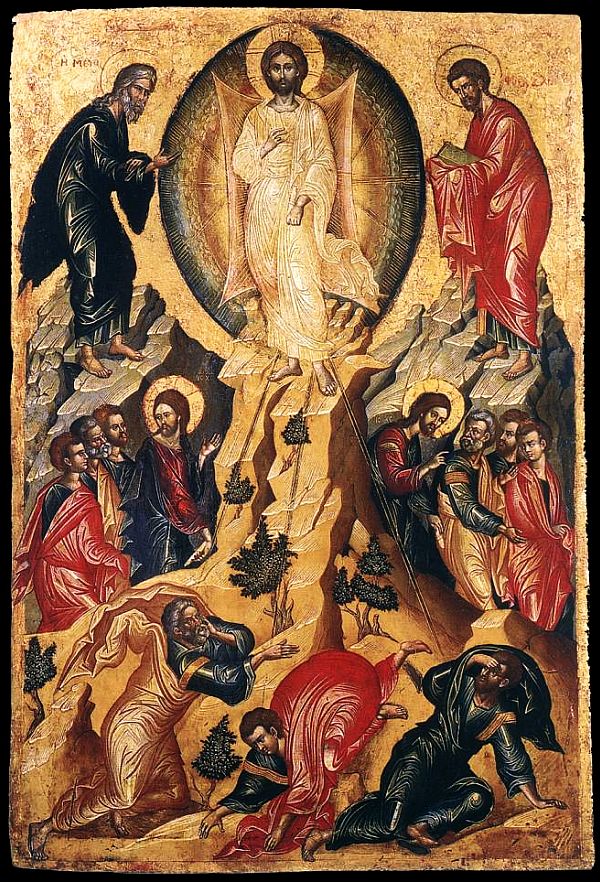
Illustration: Transfiguration of Christ (c. 1550) by an unknown Cretan icon painter at Web Gallery of Art.

Labels: , , , , , , , , , , , , , , , , , , ,

18 February 2017

Epiphany 7A Sermon: Hearsay

Preached on Matthew 5:38-48
The Seventh Sunday After the Epiphany
18 February AD 2017

Title: Click to hear the MP3 of Hearsay.

Sermon on the Mount Summary: Do good works save? Throughout Scripture, God commands them and often attaches promises to our doing them. Some will say that this is possible, but Jesus says differently: Without Him the promise is never realized, for none of us can attain the perfection of our heavenly Father though our deeds.

Yet we know that good works do save — that is, Jesus’ good works done on our behalf. The Father credits us with the Son’s keeping of the Law and counts us holy through them. We have, in Christ, already fulfilled the Law.

Now, the Holy Spirit leads us “sons of [our] Father who is in heaven” to live in love in thankful response for our salvation. And when our hearts and minds grow weary or we choose to do less than all we can, the Lord still loves us and forgives us once again ... and again ... and again.

Text: [Jesus said,] “You have heard that it was said, ‘An eye for an eye and a tooth for a tooth.’ But I say to you, Do not resist the one who is evil. But if anyone slaps you on the right cheek, turn to him the other also. And if anyone would sue you and take your tunic, let him have your cloak as well. And if anyone forces you to go one mile, go with him two miles. Give to the one who begs from you, and do not refuse the one who would borrow from you.

“You have heard that it was said, ‘You shall love your neighbor and hate your enemy.’ But I say to you, Love your enemies and pray for those who persecute you, so that you may be sons of your Father who is in heaven. For he makes his sun rise on the evil and on the good, and sends rain on the just and on the unjust. For if you love those who love you, what reward do you have? Do not even the tax collectors do the same? And if you greet only your brothers, what more are you doing than others? Do not even the Gentiles do the same?

“You therefore must be perfect, as your heavenly Father is perfect.” Matthew 5:38-48

Scripture quoted from The Holy Bible, English Standard Version®, © 2001 by Crossway Bibles, a publishing ministry of Good News Publishers. Used by permission. All rights reserved.

Audio: Click to hear the MP3 of Hearsay.

NB: A few people have had problems trying to play the inline audio with Windows Media Player. If this occurs, you can either change to QuickTime or another default browser player, copy and paste the link directly into a selected player, or download it to your computer, where it seems to work regardless of which player. Several folks have suggested VLC Player from VideoLAN.

Other Readings: Psalm 119:33-40; Leviticus 19:1-2, 9-18; 1 Corinthians 3:10-23

Labels: , , , , , , , , , , , , , , , ,

12 February 2017

Septuagesima Sermon: Tested and True

Preached on Exodus 17:1-7
Pre-Lent
12 February AD 2017

Title: Click to hear the MP3 of Tested and True.

Massah and Meribah Summary: “Massah and Meribah” — “Quarreling and Testing” — define much of the human condition. Bickering and backbiting, pushing boundaries and defying limits — these extend beyond our misbehavior toward one another: They’ve been part of man’s relationship with God since the Fall.

As we wander about in our own “wilderness of sin,” we find excuses to quarrel with each other and test God whenever anything doesn’t go exactly as we desire. And if God held our rebellions against us, we would dread His presence. Already inclined to turn away from Word and Sacrament God’s wrath against sinners could drive us completely away. Even the testings He sends to guide, instruct, purify, or strengthen His people would be misinterpreted.

Yet try as we might to push against God, He works even harder to pull back. He sent Jesus to face the most severe testing any sinner could ever face, even though His Son was sinless. Rather than quarrel with His Father, Jesus came to end our sinful, selfish quarrels with God and humanity. Jesus brings peace and reconciliation to all who believe on Him.

He sends the Holy Spirit to lead us back to the promises of our baptism, to create a desire for pure Gospel proclamation and a hunger and thirst for the blessed communion of His Son’s body and blood. He pardons us and works His good through us. He will never abandon us in this wilderness into which we are born but instead shepherds us onward, leading us toward the eternal green pastures and still waters that await His beloved sheep.

Massah and Meribah Text: All the congregation of the people of Israel moved on from the wilderness of Sin by stages, according to the commandment of the Lord, and camped at Rephidim, but there was no water for the people to drink. Therefore the people quarreled with Moses and said, “Give us water to drink.”

And Moses said to them, “Why do you quarrel with me? Why do you test the Lord?”

But the people thirsted there for water, and the people grumbled against Moses and said, “Why did you bring us up out of Egypt, to kill us and our children and our livestock with thirst?”

So Moses cried to the Lord, “What shall I do with this people? They are almost ready to stone me.”

And the Lord said to Moses, “Pass on before the people, taking with you some of the elders of Israel, and take in your hand the staff with which you struck the Nile, and go. Behold, I will stand before you there on the rock at Horeb, and you shall strike the rock, and water shall come out of it, and the people will drink.”

And Moses did so, in the sight of the elders of Israel. And he called the name of the place Massah and Meribah, because of the quarreling of the people of Israel, and because they tested the Lord by saying, “Is the Lord among us or not?” Exodus 17:1-7

Scripture quoted from The Holy Bible, English Standard Version®, © 2001 by Crossway Bibles, a publishing ministry of Good News Publishers. Used by permission. All rights reserved.

Audio: Click to hear the MP3 of Tested and True.

NB: A few people have had problems trying to play the inline audio with Windows Media Player. If this occurs, you can either change to QuickTime or another default browser player, copy and paste the link directly into a selected player, or download it to your computer, where it seems to work regardless of which player. Several folks have suggested VLC Player from VideoLAN.

Other Readings: Psalm 95:1-9; 1 Corinthians 9:24-10:5; Matthew 20:1-16

Labels: , , , , , , , , , , , , , , , ,

05 February 2017

Epiphany 5A Sermon: Excessive Righteousness

Preached on Matthew 5:13-20
The Fifth Sunday After the Epiphany
5 February AD 2017

Title: Click to hear the MP3 of Excessive Righteousness.

Christ Crucified Summary: How do you enter the kingdom of heaven? All you need to do is be more righteous than the most righteous people walking the earth. That’s all. Just exceed the holy behavior of the holiest of humankind and you might get close.

Of course, this is impossible. All too often, we are flavorless salt and unlit lamps, vastly removed from the absolute righteousness of thought, word, and deed the Law demands.

Yet because Christ lived the life we couldn’t and died the death we deserve, the Father credits us with His Son’s righteousness. We possess the excessive righteousness of Jesus Himself. Our citizenship in the kingdom is secure because we are, by grace, the sinless sons of God.

Does this mean that we ignore Jesus’ words about righteousness? Are we exempt from being salt and light? Of course not! As God’s redeemed children, we desire to do His will, to glorify Him by our public testimony. And as still fallen creatures, we also need the Law’s demands to chasten, rebuke, and slay our sinful natures. So we are driven back to the Gospel, whence we again receive forgiveness and the freedom to live in faith toward God and fervent love toward one another

Text: [Jesus said,] “You are the salt of the earth, but if salt has lost its taste, how shall its saltiness be restored? It is no longer good for anything except to be thrown out and trampled under people’s feet.

“You are the light of the world. A city set on a hill cannot be hidden. Nor do people light a lamp and put it under a basket, but on a stand, and it gives light to all in the house. In the same way, let your light shine before others, so that they may see your good works and give glory to your Father who is in heaven.

“Do not think that I have come to abolish the Law or the Prophets; I have not come to abolish them but to fulfill them. For truly, I say to you, until heaven and earth pass away, not an iota, not a dot, will pass from the Law until all is accomplished. Therefore whoever relaxes one of the least of these commandments and teaches others to do the same will be called least in the kingdom of heaven, but whoever does them and teaches them will be called great in the kingdom of heaven.

“For I tell you, unless your righteousness exceeds that of the scribes and Pharisees, you will never enter the kingdom of heaven.” Matthew 5:13-20

Scripture quoted from The Holy Bible, English Standard Version®, © 2001 by Crossway Bibles, a publishing ministry of Good News Publishers. Used by permission. All rights reserved.

Audio: Click to hear the MP3 of Excessive Righteousness.

NB: A few people have had problems trying to play the inline audio with Windows Media Player. If this occurs, you can either change to QuickTime or another default browser player, copy and paste the link directly into a selected player, or download it to your computer, where it seems to work regardless of which player. Several folks have suggested VLC Player from VideoLAN.

Other Readings: Psalm 112:1-9; Isaiah 58:3-9a; 1 Corinthians 2:1-12 (13-16)

Illustration: Christ Crucified by Carne Griffiths

Labels: , , , , , , , , , , , , , ,

29 January 2017

Epiphany 4A Sermon: Blessed

Preached on Matthew 5:1-12
The Fourth Sunday After the Epiphany
29 January AD 2017

Title: Click to hear the MP3 of Blessed.

Beatitudes Summary: “Blessed are...” those who live up to Jesus’ expectations. But who are these people? We botch every one of these seeming qualifiers. Is any of us a meek, pure peacemaker?

Obviously, there’s no way we can accrue these blessings. We neither deserve nor can we earn an inheritance on earth or in eternity. Yet even though we fail miserably, we have One who fulfilled all these conditions and then credited them to us.

Leaving Heaven’s wealth, Jesus became poor in spirit. He mourned over fallen humanity, dying friends, and His own impending death. He was meek, craved constant and full communion with His Father, showed mercy to stricken sinners, remained pure and holy, came to bring peace between God and man, and was persecuted because of His righteousness.

The blessings He earned through His life and death became His gift to us. We inherit the kingdom, receive divine comfort in all our sorrows, and are citizens not only of this earth but of the new heavens and new earth. We “taste and see that the Lord is good” and dine on Word and Sacrament to our full satisfaction. Adopted in Baptism, we are the sons of God, receiving His mercy and are guaranteed to see the Father in the Resurrection.

Text: Seeing the crowds, [Jesus] went up on the mountain, and when he sat down, his disciples came to him.

And he opened his mouth and taught them, saying: “Blessed are the poor in spirit, for theirs is the kingdom of heaven.

“Blessed are those who mourn, for they shall be comforted.

“Blessed are the meek, for they shall inherit the earth.

“Blessed are those who hunger and thirst for righteousness, for they shall be satisfied.

“Blessed are the merciful, for they shall receive mercy.

“Blessed are the pure in heart, for they shall see God.

“Blessed are the peacemakers, for they shall be called sons of God.

“Blessed are those who are persecuted for righteousness’ sake, for theirs is the kingdom of heaven.

“Blessed are you when others revile you and persecute you and utter all kinds of evil against you falsely on my account. Rejoice and be glad, for your reward is great in heaven, for so they persecuted the prophets who were before you.” Matthew 5:1-12

Scripture quoted from The Holy Bible, English Standard Version®, © 2001 by Crossway Bibles, a publishing ministry of Good News Publishers. Used by permission. All rights reserved.

Audio: Click to hear the MP3 of Blessed.

NB: A few people have had problems trying to play the inline audio with Windows Media Player. If this occurs, you can either change to QuickTime or another default browser player, copy and paste the link directly into a selected player, or download it to your computer, where it seems to work regardless of which player. Several folks have suggested VLC Player from VideoLAN.

Other Readings: Psalm 15; Micah 6:1-8; 1 Corinthians 1:18-31

Labels: , , , , , , , , , ,

27 November 2016

Advent 1A Sermon: Peace Within You

Preached on Psalm 122
The First Sunday in Advent
27 November AD 2016

Title: Peace Within You.

Zion Lutheran, Saint Louis Summary: Peace within the walls of Christ’s Church, the new Jerusalem, means peace within her inhabitants. Conflict from without should be expected since devil and world rebel against His rule. But woe to us who willfully stir up internal strife or who withhold this peace from those who need it.

Christians pray for the peace from above “which surpasses all understanding. (Philippians 4:7)” The Lord works among us, leading us to be “eager to maintain the unity of the Spirit in the bond of peace. (Ephesians 4:3)”

Text: I was glad when they said to me, “Let us go to the house of the Lord!”

Our feet have been standing within your gates, O Jerusalem! Jerusalem — built as a city that is bound firmly together, to which the tribes go up, the tribes of the Lord, as was decreed for Israel, to give thanks to the name of the Lord.

There thrones for judgment were set, the thrones of the house of David. Pray for the peace of Jerusalem! “May they be secure who love you! Peace be within your walls and security within your towers!”

For my brothers and companions’ sake I will say, “Peace be within you!” For the sake of the house of the Lord our God, I will seek your good. Psalm 122

Scripture quoted from The Holy Bible, English Standard Version®, © 2001 by Crossway Bibles, a publishing ministry of Good News Publishers. Used by permission. All rights reserved.

Audio: Click to hear the MP3 of Peace Within You

NB: A few people have had problems trying to play the inline audio with Windows Media Player. If this occurs, you can either change to QuickTime or another default browser player, copy and paste the link directly into a selected player, or download it to your computer, where it seems to work regardless of which player. Several folks have suggested VLC Player from VideoLAN.

Other Readings: Isaiah 2:1-5; Romans 13:(8-10) 11-14; Matthew 21:1-11 (alternate Gospel Matthew 24:36-44)

Illustration: Zion Lutheran Church, Saint Louis, Missouri.

Labels: , , , , , , , , , , , , , , ,

13 November 2016

Trinity 25 Sermon: Informed Encouragement

Mission Festival Sermon Preached on 1 Thessalonians 4:13-18
The Twenty-fifth Sunday after Trinity
13 November AD 2016

Title: Click to hear the MP3 of Informed Encouragement.

Resurrection of the Flesh Summary: I was invited to preach for mission festivals at two Missouri congregations, Bethlehem Lutheran, Mount Leonard and Zion Lutheran, Blackburn. I chose to use the appointed Epistle for the One Year Lectionary at each, but with slightly different emphases.

While I spoke on missions in general, I also emphasized the work of hospice chaplain. I noted also the partnership that exists between all Christians and those tending to the special needs of the dying and their families.

Text: But we do not want you to be uninformed, brothers, about those who are asleep, that you may not grieve as others do who have no hope. For since we believe that Jesus died and rose again, even so, through Jesus, God will bring with him those who have fallen asleep.

For this we declare to you by a word from the Lord, that we who are alive, who are left until the coming of the Lord, will not precede those who have fallen asleep. For the Lord himself will descend from heaven with a cry of command, with the voice of an archangel, and with the sound of the trumpet of God.

And the dead in Christ will rise first. Then we who are alive, who are left, will be caught up together with them in the clouds to meet the Lord in the air, and so we will always be with the Lord.

Therefore encourage one another with these words. 1 Thessalonians 4:13-18

Scripture quoted from The Holy Bible, English Standard Version®, © 2001 by Crossway Bibles, a publishing ministry of Good News Publishers. Used by permission. All rights reserved.

Audio: Click to hear the MP3 of Informed Encouragement, preached at Zion Lutheran Church, Blackburn, Missouri

NB: A few people have had problems trying to play the inline audio with Windows Media Player. If this occurs, you can either change to QuickTime or another default browser player, copy and paste the link directly into a selected player, or download it to your computer, where it seems to work regardless of which player. Several folks have suggested VLC Player from VideoLAN.

Other Readings: Psalm 14; Exodus 32:1-20; Matthew 24:15-18

Illustration: Luca Signorelli; Resurrection of the Flesh (1499-1502); Web Gallery of Art.

Labels: , , , , , , , , , , , , , ,

Trinity 25 Sermon: Resurrection Hope

Mission Festival Sermon Preached on 1 Thessalonians 4:13-18
The Twenty-fifth Sunday after Trinity
13 November AD 2016

Title: Click to hear the MP3 of Resurrection Hope.

Hospice Prayer Summary: I was invited to preach for mission festivals at two Missouri congregations, Bethlehem Lutheran, Mount Leonard and Zion Lutheran, Blackburn. I chose to use the appointed Epistle for the One Year Lectionary at each, but with slightly different emphases.

While I spoke on missions in general, I also emphasized the work of hospice chaplain. I noted also the partnership that exists between all Christians and those tending to the special needs of the dying and their families.

Text: But we do not want you to be uninformed, brothers, about those who are asleep, that you may not grieve as others do who have no hope. For since we believe that Jesus died and rose again, even so, through Jesus, God will bring with him those who have fallen asleep.

For this we declare to you by a word from the Lord, that we who are alive, who are left until the coming of the Lord, will not precede those who have fallen asleep. For the Lord himself will descend from heaven with a cry of command, with the voice of an archangel, and with the sound of the trumpet of God.

And the dead in Christ will rise first. Then we who are alive, who are left, will be caught up together with them in the clouds to meet the Lord in the air, and so we will always be with the Lord.

Therefore encourage one another with these words. 1 Thessalonians 4:13-18

Scripture quoted from The Holy Bible, English Standard Version®, © 2001 by Crossway Bibles, a publishing ministry of Good News Publishers. Used by permission. All rights reserved.

Audio: Click to hear the MP3 of Resurrection Hope, preached at Bethlehem Lutheran Church, Mount Leonard, Missouri

NB: A few people have had problems trying to play the inline audio with Windows Media Player. If this occurs, you can either change to QuickTime or another default browser player, copy and paste the link directly into a selected player, or download it to your computer, where it seems to work regardless of which player. Several folks have suggested VLC Player from VideoLAN.

Other Readings: Psalm 14; Exodus 32:1-20; Matthew 24:15-18

Labels: , , , , , , , , , , , , , ,

23 October 2016

Trinity 22 Sermon: The Cup of Salvation

Preached on Psalm 116:12-19 and Matthew 18:35
The Twenty-second Sunday after Trinity
23 October AD 2016

Title: Click to hear the MP3 of The Cup of Salvation.

Gill: Crucifix, Chalice & Host Summary: At the close of today’s Gospel, Jesus warns us of the consequences of not heartily forgiving those who sin against us. There’s no limit on how often: God calls us to forgive as we have been forgiven or risk forfeiting the forgiveness that is ours in Christ.

How, then, do we dare “lift up the cup of salvation”? What gives us the right to assemble “in the presence of all His people”? To do so in the “courts of the house of the Lord”?

We dare because Christ dared drink His cup of suffering and death. He drained the bitter dregs and refilled it with heaven’s most precious wine, His own blood shed for us. His cup, our salvation. In it comes full remission of our own sins.

On the cross, Jesus forgave the very people who were torturing Him to death. And not only them, He forgave everyone for whose sins He was dying—including us. As we truly grasp exactly how much He forgave, His spirit then leads us to respond by forgiving others.

Each of us stands as indebted as the servant who owed ten thousand talents, and when we realize this, the size of the debts owed to us by others appear tiny by comparison. Just as we owe God no restitution, so none of our debtors owes us.

Freed from the burdens of either paying (to God) or collecting (from others) any debts, we joyfully seek out His presence and the company of our fellow redeemed. We celebrate this freedom as we lift the cup of Christ's salvation in Christ’s Church among Christ’s people.

Italian Glass Chalice Texts: What shall I render to the Lord for all his benefits to me? I will lift up the cup of salvation and call on the name of the Lord, I will pay my vows to the Lord in the presence of all his people.

Precious in the sight of the Lord is the death of his saints.

O Lord, I am your servant; I am your servant, the son of your maidservant. You have loosed my bonds.

I will offer to you the sacrifice of thanksgiving and call on the name of the Lord. I will pay my vows to the Lord in the presence of all his people, in the courts of the house of the Lord, in your midst, O Jerusalem.

Praise the Lord! Psalm 116:12-19

[Jesus said,] “So also my heavenly Father will do to every one of you, if you do not forgive your brother from your heart.” Matthew 18:35

Scripture quoted from The Holy Bible, English Standard Version®, © 2001 by Crossway Bibles, a publishing ministry of Good News Publishers. Used by permission. All rights reserved.

Audio: Click to hear the MP3 of The Cup of Salvation

NB: A few people have had problems trying to play the inline audio with Windows Media Player. If this occurs, you can either change to QuickTime or another default browser player, copy and paste the link directly into a selected player, or download it to your computer, where it seems to work regardless of which player. Several folks have suggested VLC Player from VideoLAN.

Other Readings: Micah 6:6-8; Philippians 1:3-11; Matthew 18:21-35

Illustrations: Unknown Italian Master; Chalice (c. 1550); Web Gallery of Art. Eric Gill; Crucifix, Chalice & Host (1915); © Tate 1979, CC-BY-NC-ND 3.0 (Unported).

Labels: , , , , , , , , , , , , ,

09 October 2016

Pentecost 21 Sermon: Unbent, Unbroken, Unbounded Love

Preached on Ruth 1:1-20
The Twenty-first Sunday after Pentecost — Proper 23C
9 October AD 2016

Title: Click to hear the MP3 of Unbent, Unbroken, Unbounded Love.

Ruth 1:16-17 Summary: Aliens. Strangers. Foreigners. Outcasts. In the minds of most Israelites, Moabites were all of these and more. Israel’s cousins were familial fallout, along with the Ammonites heirs of the incest of Lot and his daughters. Worse, instead of welcoming their kin home hundreds of years later, Moab hired Balaam to curse the God’s people as Israel journeyed to the Promised Land.

In response to their treachery, the Lord cursed Moab, pronouncing them unable to rejoin full worship fellowship with their family. Even if they married into Israel and lived in their midst, their men were barred from the tabernacle “even to the tenth generation. (Deuteronomy 23:3; see also vv. 4-8)”

Yet the Lord loved these outcasts and wanted them back as His own. And when an Israelite widow and her Moabite daughter-in-law found themselves impoverished and alone, He acted. Through the love shared by Ruth and Naomi — a love flowing from His own boundless mercy and grace — He received rejected Moab into His chosen people. Ruth of Moab found herself fully accepted into the clan of Ephrathah of the tribe of Judah.

More than merely showing that He cared even for oft-despised Gentiles, the Lord included Moab in the line of the coming Davidic kingship and thus into the earthly family of the coming Savior. An heir to Adam’s rebellion, Lot’s incest, Jacob’s deceit, David’s adultery and murder — Jesus was the righteous fruit who grew from a dead and decaying family tree. He not only claimed kinship with them but He also claimed their sins as His own and took them to the cross.

However, as the Lord said of His promised Son, “It is too light a thing that you should be my servant to raise up the tribes of Jacob and to bring back the preserved of Israel; I will make you as a light for the nations, that my salvation may reach to the end of the earth. (Isaiah 49:6)” Therefore, Jesus claimed the sins of all people throughout all time — even yours and mine. We, the once-rejected, join all of the rescued, ransomed, redeemed, and restored people of God in rejoicing forevermore.

Jesus' Family Tree Text: In the days when the judges ruled there was a famine in the land, and a man of Bethlehem in Judah went to sojourn in the country of Moab, he and his wife and his two sons. The name of the man was Elimelech and the name of his wife Naomi, and the names of his two sons were Mahlon and Chilion. They were Ephrathites from Bethlehem in Judah.

They went into the country of Moab and remained there. But Elimelech, the husband of Naomi, died, and she was left with her two sons. These took Moabite wives; the name of the one was Orpah and the name of the other Ruth. They lived there about ten years, and both Mahlon and Chilion died, so that the woman was left without her two sons and her husband.

Then she arose with her daughters-in-law to return from the country of Moab, for she had heard in the fields of Moab that the Lord had visited his people and given them food. So she set out from the place where she was with her two daughters-in-law, and they went on the way to return to the land of Judah.

But Naomi said to her two daughters-in-law, “Go, return each of you to her mother's house. May the Lord deal kindly with you, as you have dealt with the dead and with me. The Lord grant that you may find rest, each of you in the house of her husband!” Then she kissed them, and they lifted up their voices and wept.

And they said to her, “No, we will return with you to your people.”

But Naomi said, “Turn back, my daughters; why will you go with me? Have I yet sons in my womb that they may become your husbands? Turn back, my daughters; go your way, for I am too old to have a husband. If I should say I have hope, even if I should have a husband this night and should bear sons, would you therefore wait till they were grown? Would you therefore refrain from marrying? No, my daughters, for it is exceedingly bitter to me for your sake that the hand of the Lord has gone out against me.”

Then they lifted up their voices and wept again.

And Orpah kissed her mother-in-law, but Ruth clung to her. And she said, “See, your sister-in-law has gone back to her people and to her gods; return after your sister-in-law.”

But Ruth said, “Do not urge me to leave you or to return from following you. For where you go I will go, and where you lodge I will lodge. Your people shall be my people, and your God my God. Where you die I will die, and there will I be buried. May the Lord do so to me and more also if anything but death parts me from you.” And when Naomi saw that she was determined to go with her, she said no more.

So the two of them went on until they came to Bethlehem. And when they came to Bethlehem, the whole town was stirred because of them. And the women said, “Is this Naomi?”

She said to them, “Do not call me Naomi; call me Mara, for the Almighty has dealt very bitterly with me. Ruth 1:1-20

Scripture quoted from The Holy Bible, English Standard Version®, © 2001 by Crossway Bibles, a publishing ministry of Good News Publishers. Used by permission. All rights reserved.

Audio: Click to hear the MP3 of Unbent, Unbroken, Unbounded Love

NB: A few people have had problems trying to play the inline audio with Windows Media Player. If this occurs, you can either change to QuickTime or another default browser player, copy and paste the link directly into a selected player, or download it to your computer, where it seems to work regardless of which player. Several folks have suggested VLC Player from VideoLAN.

Other Readings: Psalm 111; 2 Timothy 2:1-13; Luke 17:11-19

Labels: , , , , , , , , , , , , , , , , ,