Happenings

Sermons by Pastor Walter Snyder plus announcements, articles, videos, and anything else that doesn’t fit Ask the Pastor or the Luther Library.


26 April 2020

Easter 3A Sermon: Necessary Evil

Preached on Luke 24:13–35
The Third Sunday of Easter (Series A)
Responsive Prayer 2 (LSB 285)
26 April AD 2020

Video: Click to view the YouTube video of Necessary Evil. Responsive Prayer 2 from the Lutheran Service Book begins with the Opening Versicles (LSB 285), Psalm 116:1–14, and the Readings. The sermon starts at the 7:45 mark. The service concludes with the Kyrie (LSB 285), Lord’s Prayer (LSB 285), Apostles’ Creed (LSB 286), Versicles (286), Collect of the Day, Collect During an Epidemic, Morning Prayer (LSB 287), Benedicamus (LSB 287), and Benediction (LSB 287).

Audio: Alternatively, choose Necessary Evil, MP3 audio of the sermon only.

Luke 24:13–35 Summary: When we talk about “necessary evils,” we normally mean something harsh or painful that we must endure in order to reach a satisfactory and pleasing conclusion. At times, we even use “necessary evil” as another way of saying, “The ends justify the means” — in other words, an excuse to take short-cuts or to sin in some way in order to achieve our goal.

Jesus enlightened the disciples on the Emmaus Road by showing them from the Scriptures that He endured the necessary evil of suffering before achieving His goal and entering glory. Because He endured the necessary, prophesied evils of betrayal, abandonment, torture, and death, the Lord destroyed the power of sin and death and won for us everlasting life.

Text: That very day two of them were going to a village named Emmaus, about seven miles from Jerusalem, and they were talking with each other about all these things that had happened. While they were talking and discussing together, Jesus himself drew near and went with them. But their eyes were kept from recognizing him.

And he said to them, “What is this conversation that you are holding with each other as you walk?”

And they stood still, looking sad. Then one of them, named Cleopas, answered him, “Are you the only visitor to Jerusalem who does not know the things that have happened there in these days?”

And he said to them, “What things?”

And they said to him, “Concerning Jesus of Nazareth, a man who was a prophet mighty in deed and word before God and all the people, and how our chief priests and rulers delivered him up to be condemned to death, and crucified him. But we had hoped that he was the one to redeem Israel. Yes, and besides all this, it is now the third day since these things happened.

“Moreover, some women of our company amazed us. They were at the tomb early in the morning, and when they did not find his body, they came back saying that they had even seen a vision of angels, who said that he was alive. Some of those who were with us went to the tomb and found it just as the women had said, but him they did not see.”

And he said to them, “O foolish ones, and slow of heart to believe all that the prophets have spoken! Was it not necessary that the Christ should suffer these things and enter into his glory?” And beginning with Moses and all the Prophets, he interpreted to them in all the Scriptures the things concerning himself.

So they drew near to the village to which they were going. He acted as if he were going farther, but they urged him strongly, saying, “Stay with us, for it is toward evening and the day is now far spent.” So he went in to stay with them.

When he was at table with them, he took the bread and blessed and broke it and gave it to them. And their eyes were opened, and they recognized him. And he vanished from their sight. They said to each other, “Did not our hearts burn within us while he talked to us on the road, while he opened to us the Scriptures?”

And they rose that same hour and returned to Jerusalem. And they found the eleven and those who were with them gathered together, saying, “The Lord has risen indeed, and has appeared to Simon!” Then they told what had happened on the road, and how he was known to them in the breaking of the bread. Luke 24:13–35

Scripture quoted from The Holy Bible, English Standard Version®, © 2001 by Crossway Bibles, a publishing ministry of Good News Publishers. Used by permission. All rights reserved.

Video: Click to view the YouTube video of Necessary Evil. Sermon begins at the 7:45 mark.

Audio: Click Necessary Evil for MP3 audio of just the sermon.

Other Readings: Psalm 116:1–14; Acts 2:14a, 36–41; 1 Peter 1:17–25

Labels: , , , , , , , , , ,

10 April 2020

Good Friday Sermon: Sympathy with Our Weakness

Preached on Hebrews 4:14–16; 5:7–9
Good Friday
Scriptures, Prayers, and Sermon
10 April AD 2020

Video: Click to view the YouTube video of Sympathy with Our Weakness.

Sermon starts at the 12:55 mark, following appointed Scriptures and collects for the day. Service concludes with the Bidding Prayer and the Lord’s Prayer.

Apology: I’m sorry for video quality. A camera setting was changed and I didn’t notice until the filming was complete.

Hebrews 4:14-16; 5:5-7 Summary: How many times have you heard or said, “I know how you feel”? Usually intended as words of comfort and support, they usually ring hollow because no one truly and completely knows how another feels. We may guess well, come close, or share identical or near-identical trials but each of us still experiences our pains personally and individually.

So how can the writer of Hebrews tell us that our High Priest Jesus sympathizes totally with every one of us? Your pains and struggles are so very different from mine — yet Jesus not only sympathizes with each of us but also feels each of our individual pains so deeply that it defies our comprehension.

Jesus faced the pains and pleasures that confront us and so often lead us astray. However, none of these could bully, scare, persuade, or entice Him from the path that He walked toward His death and our redemption. He knows what we fear and what we crave. His resistance to the temptations that accompany threats of pain or promises of pleasure paid for our failure to overcome.

When the Holy Spirit creates faith and ignites Christ’s love in us, He leads us to believe in and embrace our cross-won forgiveness. He also increases our ability and our desire to love others and helps us to power through temptations that would otherwise trip us up. The deeper we know Jesus’ sympathy for us, the better equipped we are to truly sympathize with others.

Jesus learned our pain as He passed through life and death before He reentered bliss as He ascended through the heavens to His Father, in whose presence He intercedes on our behalf. He leads us to follow Him, that we might live here in faith toward God and fervent love toward others. He promises that we then will also enter eternal joy in the presence of His Father.

Text: Since then we have a great high priest who has passed through the heavens, Jesus, the Son of God, let us hold fast our confession. For we do not have a high priest who is unable to sympathize with our weaknesses, but one who in every respect has been tempted as we are, yet without sin. Let us then with confidence draw near to the throne of grace, that we may receive mercy and find grace to help in time of need.

In the days of his flesh, Jesus offered up prayers and supplications, with loud cries and tears, to him who was able to save him from death, and he was heard because of his reverence. Although he was a son, he learned obedience through what he suffered. And being made perfect, he became the source of eternal salvation to all who obey him. Hebrews 4:14–16; 5:7–9

Scripture quoted from The Holy Bible, English Standard Version®, © 2001 by Crossway Bibles, a publishing ministry of Good News Publishers. Used by permission. All rights reserved.

Video: Click to view the YouTube video of Sympathy with Our Weakness. Sermon begins at the 11:20 mark.

Other Readings: Psalm 22; Isaiah 52:13–53:12; John 19:17-30

Labels: , , , , , , , ,

24 November 2019

Last Sunday of the Church Year Sermon: Green Wood, Dry Wood

Preached on Luke 23:27–43
Last Sunday of the Church Year — Proper 29C
24 November AD 2019

Title: Click to hear the MP3 of Green Wood, Dry Wood

Luke 23:31a Summary: In today’s Gospel, Luke shows Jesus prophesying the fall of Jerusalem for the third time in less than a week. Its fall is tied both to his own death and to the end of the world. God’s judgment on sin will fall all who reject His Word and His will. Jerusalem becomes a sign for the Last Judgment.

Jesus shows how bad it is in His comparison: He — the green wood innocent and holy — should be impervious to destruction and flame. Yet sinners are taking Him out to be crucified. Meanwhile, sinful humankind is dry, brittle, and easily put to the torch. What will happen to us?

Our salvation only comes when we trust that divine judgment on sin already fell on Jesus. God put our guilt on His Son and sent Him to die for us. When we believe that He carried our sins to the cross, we possess the salvation and new life that came in His resurrection.

Luke 23:31b Text: And there followed [Jesus] a great multitude of the people and of women who were mourning and lamenting for him.

But turning to them Jesus said, “Daughters of Jerusalem, do not weep for me, but weep for yourselves and for your children. For behold, the days are coming when they will say, ‘Blessed are the barren and the wombs that never bore and the breasts that never nursed!’ Then they will begin to say to the mountains, ‘Fall on us,’ and to the hills, ‘Cover us.’

“For if they do these things when the wood is green, what will happen when it is dry?”

Two others, who were criminals, were led away to be put to death with him. And when they came to the place that is called The Skull, there they crucified him, and the criminals, one on his right and one on his left. And Jesus said, “Father, forgive them, for they know not what they do.”

And they cast lots to divide his garments. And the people stood by, watching, but the rulers scoffed at him, saying, “He saved others; let him save himself, if he is the Christ of God, his Chosen One!” The soldiers also mocked him, coming up and offering him sour wine and saying, “If you are the King of the Jews, save yourself!” There was also an inscription over him, “This is the King of the Jews.”

One of the criminals who were hanged railed at him, saying, “Are you not the Christ? Save yourself and us!”

But the other rebuked him, saying, “Do you not fear God, since you are under the same sentence of condemnation? And we indeed justly, for we are receiving the due reward of our deeds; but this man has done nothing wrong.” And he said, “Jesus, remember me when you come into your kingdom.”

And he said to him, “Truly, I say to you, today you will be with me in paradise.” Luke 23:27-43

Scripture quoted from The Holy Bible, English Standard Version®, © 2001 by Crossway Bibles, a publishing ministry of Good News Publishers. Used by permission. All rights reserved.

Audio: Click to hear the MP3 of Green Wood, Dry Wood

NB: For some reason, a few people have had problems trying to play the inline audio if Windows Media is their default MP3 player. If this occurs, you can either change to QuickTime or another default browser player, copy and paste the link directly into a selected player, or download it to your computer, where it seems to work regardless of which player. Several folks have suggested VLC Player from VideoLAN.

Other Readings: Psalm 46; Malachi 3:13-18; Colossians 1:13-20

Labels: , , , , , , ,

13 August 2017

Pentecost 10 Sermon: Dying with God

Preached on Job 38:4-18
10th Sunday After Pentecost— Proper 14A
13 August AD 2017

Title: Click to hear the MP3 of Dying with God.

Resurrection Summary: When the Lord challenges us as He did Job, we can certainly answer one of His questions in the affirmative: “The gates of death” have been revealed to us. Christ burst them open and tore them down. We passed through them in Baptism. For in Baptism, we died with Jesus on the cross and in Baptism we crossed over to everlasting life in Him.

Text: [The Lord said to Job,] “Where were you when I laid the foundation of the earth? Tell me, if you have understanding. Who determined its measurements — surely you know! Or who stretched the line upon it? On what were its bases sunk, or who laid its cornerstone, when the morning stars sang together and all the sons of God shouted for joy?

“Or who shut in the sea with doors when it burst out from the womb, when I made clouds its garment and thick darkness its swaddling band, and prescribed limits for it and set bars and doors, and said, ‘Thus far shall you come, and no farther, and here shall your proud waves be stayed’?

“Have you commanded the morning since your days began, and caused the dawn to know its place, that it might take hold of the skirts of the earth, and the wicked be shaken out of it?

“It is changed like clay under the seal, and its features stand out like a garment. From the wicked their light is withheld, and their uplifted arm is broken.

“Have you entered into the springs of the sea, or walked in the recesses of the deep? Have the gates of death been revealed to you, or have you seen the gates of deep darkness? Have you comprehended the expanse of the earth? Declare, if you know all this.” Job 38:4-18

Scripture quoted from The Holy Bible, English Standard Version®, © 2001 by Crossway Bibles, a publishing ministry of Good News Publishers. Used by permission. All rights reserved.

Audio: Click to hear the MP3 of Dying with God.

NB: A few people have had problems trying to play the inline audio with Windows Media Player. If this occurs, you can either change to QuickTime or another default browser player, copy and paste the link directly into a selected player, or download it to your computer, where it seems to work regardless of which player. Several folks have suggested VLC Player from VideoLAN.

Other Readings: Psalm 18:1-6 (7-16); Romans 10:5-17; Matthew 14:22-33

Labels: , , , , , , , , , , , , , , , , ,

14 August 2016

Pentecost 13 Sermon: Knowing the Signs

Preached on Luke 12:49-56
The Thirteenth Sunday after Pentecost — Proper 15C
14 August AD 2016

Title: Knowing the Signs (MP3 Audio)

Luke 12:49-56 Summary: Full and free forgiveness for the sake of Jesus Christ isn’t a popular message. Some think they have no need to be saved while others believe that they can save themselves — or at least participate in their salvation. The discord stirred up by Jesus’ ministry has only increased through the years.

Yet for those who believe in Him, the very Word that divides sinful mankind unites sinners with their loving Father, giving them peace with God and the only possibility of true harmony with other people. But if we don’t recognize the sign of our own sinfulness, we are unable to see the need for forgiveness. And if we don’t know the sign of Christ crucified, we miss the only means by which we have true peace and eternal life.

While some of the specific trials and afflictions noted may belong especially to the nursing home residents to whom I was preaching, they generally pertain to all humanity, particularly when age, accident, illness, or isolation become part of everyday life.

Text: [Jesus said,] “I came to cast fire on the earth, and would that it were already kindled! I have a baptism to be baptized with, and how great is my distress until it is accomplished! Do you think that I have come to give peace on earth? No, I tell you, but rather division. For from now on in one house there will be five divided, three against two and two against three. They will be divided, father against son and son against father, mother against daughter and daughter against mother, mother-in-law against her daughter-in-law and daughter-in-law against mother-in-law.”

He also said to the crowds, “When you see a cloud rising in the west, you say at once, ‘A shower is coming.’ And so it happens. And when you see the south wind blowing, you say, ‘There will be scorching heat,’ and it happens. You hypocrites! You know how to interpret the appearance of earth and sky, but why do you not know how to interpret the present time?” Luke 12:49-56

Scripture quoted from The Holy Bible, English Standard Version®, © 2001 by Crossway Bibles, a publishing ministry of Good News Publishers. Used by permission. All rights reserved.

Audio: Click to hear the MP3 of Knowing the Signs

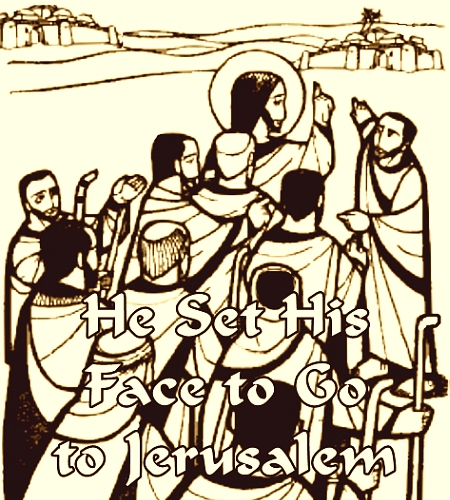
Illustration: Line drawing from Art of the Church Year by Ed Riojas, available through Higher Things Store.

NB: A few people have had problems trying to play the inline audio with Windows Media Player. If this occurs, you can either change to QuickTime or another default browser player, copy and paste the link directly into a selected player, or download it to your computer, where it seems to work regardless of which player. Several folks have suggested VLC Player from VideoLAN.

Other Readings: Psalm 119:81-88; Jeremiah 23:16-29; Hebrews 11:17-12:3

Labels: , , , , , , , , , , , , , , ,

26 June 2016

Pentecost 6 Sermon: Dead Set

Preached on Luke 9:51-62
The Sixth Sunday after Pentecost — Proper 8C
26 June AD 2016

Title: Dead Set (MP3 Audio)

Luke 9:51 Summary: Plowing, driving, even walking — in each of these endeavors, we find ourselves going quickly off-track if we don’t remain focused on where we’re going. When Jesus spoke to those who would be His disciples, He demanded that they drop all they had, ignore temptations to look away, and follow Him wherever He led.

Yet not one of His followers remained completely faithful. None of the Twelve remained with Him when he was captured in the garden. Similarly, we may gasp the plow handles of discipleship but we find it impossible to stay the course.

Yet we fear not because we know that Jesus remained on-task and on-target. Because He was dead set upon reaching Jerusalem in order to suffer and die for all mankind, He earned forgiveness for all whose faith wavers or whose walk wanders away. He was fixed on the Holy City because He was fixed on us. He never lost sight of those sinners He’d come to save.

Now, through Word and Sacrament, the Holy Spirit continually works to keep our eyes fixed on Jesus (see Hebrews 12:2) in order that we might remain with the Savior who remains with us. He keeps us focuses on Christ that we might always receive forgiveness, life, and salvation.

Jesus never looked back or turned away. He plowed straight toward His death that we might follow Him to life everlasting.

Luke 9:62 Text: When the days drew near for him to be taken up, he set his face to go to Jerusalem. And he sent messengers ahead of him, who went and entered a village of the Samaritans, to make preparations for him. But the people did not receive him, because his face was set toward Jerusalem.

And when his disciples James and John saw it, they said, “Lord, do you want us to tell fire to come down from heaven and consume them?”

But he turned and rebuked them. And they went on to another village.

As they were going along the road, someone said to him, “I will follow you wherever you go.”

And Jesus said to him, “Foxes have holes, and birds of the air have nests, but the Son of Man has nowhere to lay his head.”

To another he said, “Follow me.”

But he said, “Lord, let me first go and bury my father.”

And Jesus said to him, “Leave the dead to bury their own dead. But as for you, go and proclaim the kingdom of God.”

Yet another said, “I will follow you, Lord, but let me first say farewell to those at my home.”

Jesus said to him, “No one who puts his hand to the plow and looks back is fit for the kingdom of God.” Luke 9:51-62

Scripture quoted from The Holy Bible, English Standard Version®, © 2001 by Crossway Bibles, a publishing ministry of Good News Publishers. Used by permission. All rights reserved.

Audio: Click to hear the MP3 of Dead Set.

NB: A few people have had problems trying to play the inline audio with Windows Media Player. If this occurs, you can either change to QuickTime or another default browser player, copy and paste the link directly into a selected player, or download it to your computer, where it seems to work regardless of which player. Several folks have suggested VLC Player from VideoLAN.

Other Readings: Psalm 16; 1 Kings 19:9b-21; Galatians 5:1, 13-25

Labels: , , , , , , , , , , , , , , ,

25 March 2016

Good Friday Sermon: More Than a Feeling

Preached on Luke 23:26-49
The Passion of Our Lord
25 March AD 2016

Title: More Than a Feeling (MP3 Audio)

The Crucifixion Summary: Now that Daylight Saving Time begins so early in the year, many people complain that Good Friday evening services or the Easter Vigil don’t feel right because the skies are too light. While for some, it’s a minor complaint, it seems that others truly believe that they’re not getting the full effect of these services.

However, whatever our feelings, we must return to the facts. Regardless of the time of year — and in the Southern Hemisphere, it’s already autumn — and whatever our preferences, all that truly matters is what today proclaims. Good Friday is all about the crucifixion of the Christ.

No matter how light or dark the evening nor how bright or dark our mood, no matter our feelings and preferences, the day counts for naught without the simple, objective truth of God’s love for sinners. It’s more than a feeling — it’s a cold, hard, bright, beautiful fact: Jesus suffered and died to forgive our sins and win for us life everlasting.

Text: And as they led him away, they seized one Simon of Cyrene, who was coming in from the country, and laid on him the cross, to carry it behind Jesus.

And there followed him a great multitude of the people and of women who were mourning and lamenting for him. But turning to them Jesus said, “Daughters of Jerusalem, do not weep for me, but weep for yourselves and for your children. For behold, the days are coming when they will say, ‘Blessed are the barren and the wombs that never bore and the breasts that never nursed!’ Then they will begin to say to the mountains, ‘Fall on us,’ and to the hills, ‘Cover us.’ For if they do these things when the wood is green, what will happen when it is dry?”

Good Friday Two others, who were criminals, were led away to be put to death with him. And when they came to the place that is called The Skull, there they crucified him, and the criminals, one on his right and one on his left. And Jesus said, “Father, forgive them, for they know not what they do.” And they cast lots to divide his garments.

And the people stood by, watching, but the rulers scoffed at him, saying, “He saved others; let him save himself, if he is the Christ of God, his Chosen One!” The soldiers also mocked him, coming up and offering him sour wine and saying, “If you are the King of the Jews, save yourself!” There was also an inscription over him, “This is the King of the Jews.”

One of the criminals who were hanged railed at him, saying, “Are you not the Christ? Save yourself and us!” But the other rebuked him, saying, “Do you not fear God, since you are under the same sentence of condemnation? And we indeed justly, for we are receiving the due reward of our deeds; but this man has done nothing wrong.” And he said, “Jesus, remember me when you come into your kingdom.”

And he said to him, “Truly, I say to you, today you will be with me in Paradise.”

It was now about the sixth hour, and there was darkness over the whole land until the ninth hour, while the sun’s light failed. And the curtain of the temple was torn in two. Then Jesus, calling out with a loud voice, said, “Father, into your hands I commit my spirit!” And having said this he breathed his last.

Now when the centurion saw what had taken place, he praised God, saying, “Certainly this man was innocent!” And all the crowds that had assembled for this spectacle, when they saw what had taken place, returned home beating their breasts. And all his acquaintances and the women who had followed him from Galilee stood at a distance watching these things. Luke 23:26-49

Scripture quoted from The Holy Bible, English Standard Version®, © 2001 by Crossway Bibles, a publishing ministry of Good News Publishers. Used by permission. All rights reserved.

Audio: Click to hear the MP3 of More Than a Feeling.

NB: For some reason, a few people have had problems trying to play the inline audio if Windows Media is their default MP3 player. If this occurs, you can either change to QuickTime or another default browser player, copy and paste the link directly into a selected player, or download it to your computer, where it seems to work regardless of which player. Several folks have suggested VLC Player from VideoLAN.

Other Readings: Psalm 22 or Psalm 31; Isaiah 52:13-53:12; Hebrews 4:14-16, 5:7-9; John 18:1-19:42 or John 19:17-30

Labels: , , , , , , , , , , , , , , ,

20 March 2016

Palm Sunday C Sermon: Hosanna, Jesus!

Preached on John 12:12-19
Sunday of the Passion, Series C
20 March AD 2016

Title: Hosanna, Jesus! (MP3 Audio)

Palm Sunday Summary: The people of Jerusalem understood the word play as they called out to Jesus during His triumphal entry — yet they remained unaware of what they were asking for. Hosanna and Jesus stem from the same Hebrew word, meaning “to save.” They point to the same fact: The Word became flesh to save us from our sin. That’s why the angel told Joseph to name Mary’s Child “Jesus” (Matthew 1:21).

The crowd called upon the Savior to save them from Roman occupation, to restore the Davidic Kingdom in the Promised Land, and to restore Israel to its long-lost glory. What they got was a Savior who came to save them from satanic oppression, their own sinful natures, and God’s wrath.

Often, we are similarly unaware of our own full need for a Savior. Our cries of hosanna too often address the effects of being sinners living in a sinful world rather than the root cause of all our troubles. While we may not be looking for a new king to be crowned, we can certainly invent our own theologies of glory.

Yet even when we aren’t completely mindful of the extent of Jesus’ sacrifice on our behalf, He remains mindful of us. The fulness of His victory is ours in Word and Sacrament, by the power of the Holy Spirit. He saves us in Baptism, in the Absolution, in His Supper. He saves us by bringing us into the community of the Church. He saves us by giving the angels charge over us. He saves us by holding fast to us, even though our grip on Him often fails.

Good Friday Text: The next day the large crowd that had come to the feast heard that Jesus was coming to Jerusalem. So they took branches of palm trees and went out to meet him, crying out, “Hosanna! Blessed is he who comes in the name of the Lord, even the King of Israel!”

And Jesus found a young donkey and sat on it, just as it is written, “Fear not, daughter of Zion; behold, your king is coming, sitting on a donkey’s colt!”

His disciples did not understand these things at first, but when Jesus was glorified, then they remembered that these things had been written about him and had been done to him.

The crowd that had been with him when he called Lazarus out of the tomb and raised him from the dead continued to bear witness. The reason why the crowd went to meet him was that they heard he had done this sign.

So the Pharisees said to one another, “You see that you are gaining nothing. Look, the world has gone after him.” John 12:12-19 (Palm Sunday Processional Gospel)

Scripture quoted from The Holy Bible, English Standard Version®, © 2001 by Crossway Bibles, a publishing ministry of Good News Publishers. Used by permission. All rights reserved.

Audio: Click to hear MP3 of Hosanna, Jesus!.

NB: For some reason, a few people have had problems trying to play the inline audio if Windows Media is their default MP3 player. If this occurs, you can either change to QuickTime or another default browser player, copy and paste the link directly into a selected player, or download it to your computer, where it seems to work regardless of which player. Several folks have suggested VLC Player from VideoLAN.

Other Readings: Psalm 118:19-29 or 31:9-16; Deuteronomy 32:36-39; Philippians 2:5-11; Luke 23:1-56 or Luke 22:1-23:56 or John 12:20-43

See Aardvark Alley for more on Palm Sunday.

Labels: , , , , , , , , , , , , , ,

20 February 2016

Lent 2C Sermon: The Lord Will Relent

Preached on Jeremiah 26:8-15
The Second Sunday in Lent, Series C
21 February AD 2016

Title: The Lord Will Relent (MP3 Audio)

Luke 13:34 Summary: Unfortunately, God’s Word finds some of its strongest resistance in His Church, among His people. In today’s Gospel, Jesus pointed out Jerusalem’s sorry record of murdering the Lord’s messengers. Yet neither He nor His Father had given up on Israel and soon He would join the Holy City’s martyred prophets, shedding His blood to pay for Israel’s sins and the sins of all mankind.

Jeremiah clearly show that ignoring the Word and assaulting its proclaimers wasn’t a problem new to Jesus. The prophet came to rebuke and chastise the city and the nation, directly accusing Judah’s inhabitants of all manner of wickedness. From the greatest to the least, none escaped the Law’s condemnations.

Yet Jeremiah wasn’t there only to condemn but also to proclaim full forgiveness from a gracious Lord — a Lord who was eager to “repent of the disaster” at hand. He longed to relent of His judgment. He desired a vibrant, active Church. He wanted a population of forgiven, joyous children filling the nation.

To this day, sinners — both within and without Christendom — resist the Word. They reject God’s judgments and scorn His mercy. Individuals, congregations, and entire church bodies find ways to substitute their own thoughts and wishes for the will of the Lord. Even pew-sitting, offering-giving, congregation-serving Christians — even you and I — may find ourselves at odds with God’s Word and in conflict with His messengers.

Thanks be to God that Christ didn’t turn His back on going up to Jerusalem to be the next of the slain prophets. For the same forgiveness that He won for those who crucified Him belonged also to those who rejected and killed His prophets, who rebelled in the Wilderness, who sinned in the garden. And yes, Jesus’ forgiveness also belongs to us modern-day rebels. For the sake of His Son, the Lord relents of our judgment and gives us His pardon and His peace.

God grant that we unworthy outlaws continue to believe in Christ’s sacrifice, receive His forgiveness, and — by the power of the Holy Spirit — live lives of faith toward God and fervent love toward one another.

Jeremiah at the Temple Text: And when Jeremiah had finished speaking all that the Lord had commanded him to speak to all the people, then the priests and the prophets and all the people laid hold of him, saying, “You shall die! Why have you prophesied in the name of the Lord, saying, ‘This house shall be like Shiloh, and this city shall be desolate, without inhabitant’?” And all the people gathered around Jeremiah in the house of the LORD.

When the officials of Judah heard these things, they came up from the king’s house to the house of the Lord and took their seat in the entry of the New Gate of the house of the Lord. Then the priests and the prophets said to the officials and to all the people, “This man deserves the sentence of death, because he has prophesied against this city, as you have heard with your own ears.”

Then Jeremiah spoke to all the officials and all the people, saying, “The Lord sent me to prophesy against this house and this city all the words you have heard. Now therefore mend your ways and your deeds, and obey the voice of the Lord your God, and the Lord will relent of the disaster that he has pronounced against you.

“But as for me, behold, I am in your hands. Do with me as seems good and right to you. Only know for certain that if you put me to death, you will bring innocent blood upon yourselves and upon this city and its inhabitants, for in truth the Lord sent me to you to speak all these words in your ears.” Jeremiah 26:8-15

Scripture quoted from The Holy Bible, English Standard Version®, © 2001 by Crossway Bibles, a publishing ministry of Good News Publishers. Used by permission. All rights reserved.

Audio: Click to hear MP3 of The Lord Will Relent

NB: For some reason, a few people have had problems trying to play the inline audio if Windows Media is their default MP3 player. If this occurs, you can either change to QuickTime or another default browser player, copy and paste the link directly into a selected player, or download it to your computer, where it seems to work regardless of which player. Several folks have suggested VLC Player from VideoLAN.

Other Readings: Psalm 4; Philippians 3:17-4:1; Luke 13:31-35

Labels: , , , , , , , , , , , , , , , ,